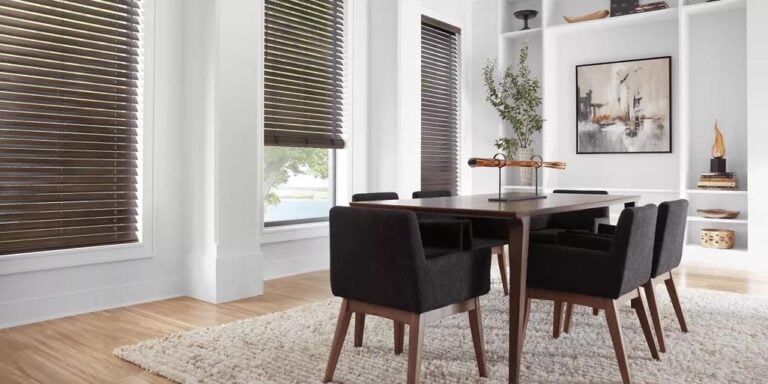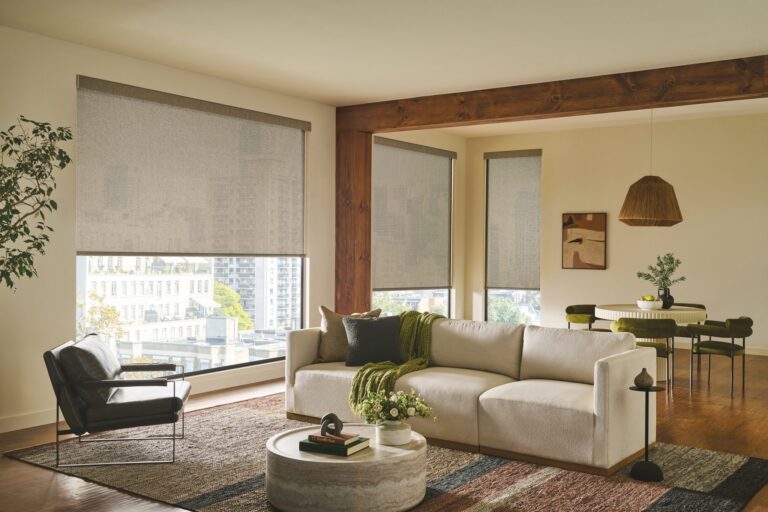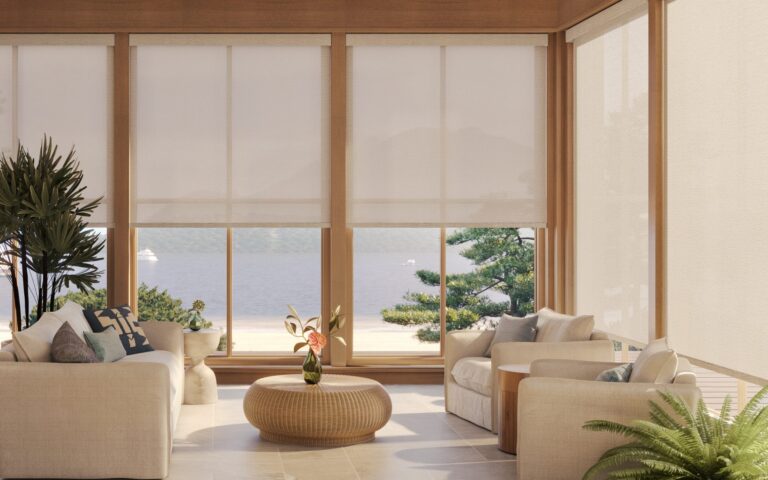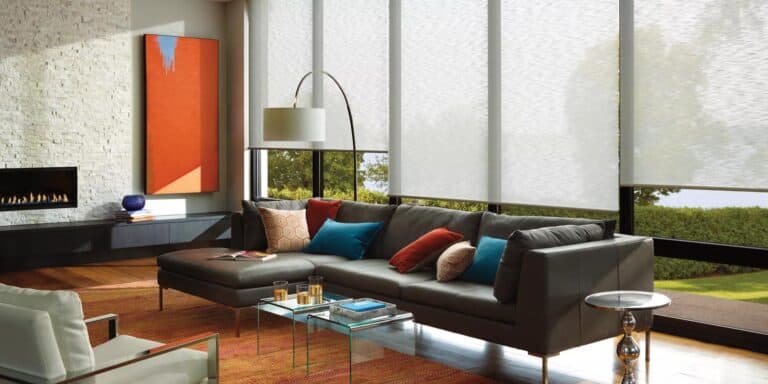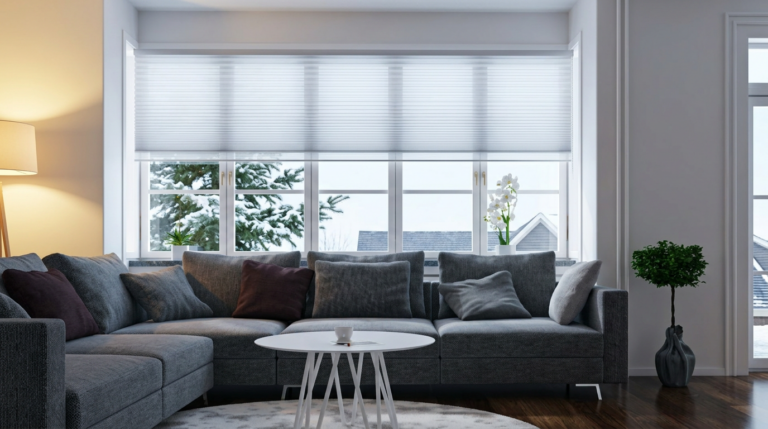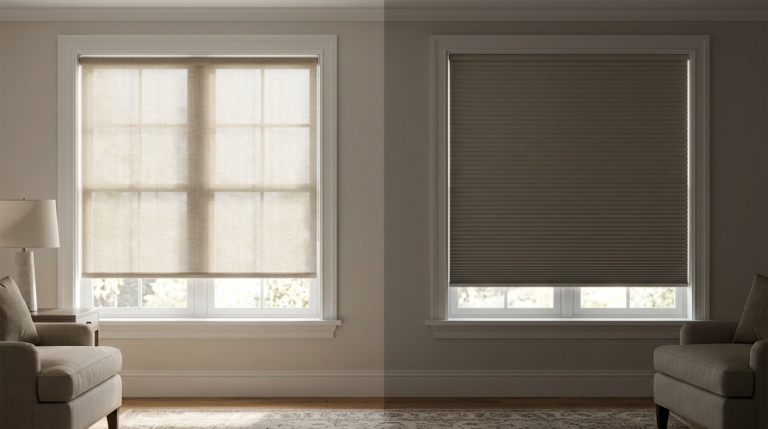

Learning how to choose between faux wood blinds and roller shades comes down to balancing adjustable directional light against sleek, low-profile solar management. For humid bathrooms or street-facing windows that need tiltable privacy, durable EverWood® alternative wood blinds provide dependable moisture resistance and traditional charm. For living spaces where glare and the outdoor view both matter, Designer Screen Shades can filter sunlight while preserving a view; the fabric choice determines how much light passes through.
Overview
Selecting the right window covering requires assessing how light control, window frame depth, and interior humidity interact across different spaces in a home. Compare the room’s humidity, the view you want when the covering is lowered, and the space available for mounting.
- Slatted Versus Rolling: Compare light redirection methods through daylight control differences across both styles.
- Moisture Performance: Review non-porous composite durability and wet room reliability in splash zones.
- Thermal Dynamics: Assess UV blocking and solar heat gain across large window spans.
- Living Area Hardware: Examine operating mechanisms and daily light management options for main floors.
- Real-World Example: Walk through a labeled real-world hypothetical covering casing depth, frame tolerances, and casing depth constraints.
- Modern Architecture: Evaluate fabric rolling mechanisms and contemporary operating systems for open floor plans.
Deciding how to choose between faux wood blinds and roller shades comes down to how you balance directional light control, physical clearance, and room humidity. Horizontal faux wood treatments, such as Hunter Douglas EverWood® Alternative Wood Blinds, use pivoting composite slats that tilt to deflect glare upward while preserving daytime privacy. Roller treatments, including Designer Roller Shades and Designer Solar Shades, operate as a single continuous textile panel that lifts vertically into an overhead tube or cassette, clearing the glass pane entirely.
Daily durability in variable indoor conditions also separates these window coverings. EverWood® blinds stand up to humidity, making them an option for bathrooms and laundry rooms where wood blinds need protection from steam and high moisture. Designer Screen Shades are available for unusually wide windows; confirm the dimensions and mounting options for the fabric and configuration you choose.
Learning how to choose between faux wood blinds and roller shades comes down to balancing adjustable directional light against sleek, low-profile solar management. For humid bathrooms or street-facing windows that need tiltable privacy, durable EverWood® alternative wood blinds provide dependable moisture resistance and traditional charm. For living spaces where glare and the outdoor view both matter, Designer Screen Shades can filter sunlight while preserving a view; the fabric choice determines how much light passes through.
Mechanical Operation and Daylight Control Differences
Controlling sunlight across large windows in Edmonton requires understanding how distinct physical builds handle daily operation. Horizontal faux wood treatments rely on individual composite slats suspended by braided ladder cords. In contrast, roller treatments utilize a continuous fabric sheet attached to an overhead tube. When managing incoming daylight, horizontal slats tilt along an internal gear, allowing homeowners to deflect direct glare toward the ceiling while maintaining street privacy below. Roller shades raise or lower a fabric panel; for solar shades, fabric openness affects both sunlight filtering and the view through the lowered shade.
Stacking dimensions also separate these two configurations when fully raised. Outfitting rooms with Hunter Douglas® EverWood® Alternative Wood Blinds creates a solid slat cluster that collects below the headrail, taking up several inches of upper window glass. On the other hand, Hunter Douglas® Designer Roller Shades roll cleanly into a slim headbox or cassette, leaving the viewing area fully open. Some Designer Screen Shades can cover unusually wide windows in a single span; the permitted width depends on the selected product and configuration.
| Operational Element | Faux Wood Blinds | Roller Shades |
|---|---|---|
| Light Direction Method | Internal tilt mechanism rotates slats up or down | Single fabric panel raises or lowers vertically |
| Open View Profile | Slats gather into a stacked bundle at the window top | Textile rolls into a compact top cassette or bracket |
| Wide Window Handling | Check the selected blind’s available width and mounting requirements; do not assume one unit will fit every opening. | Some Designer Screen Shades are available for unusually wide windows; verify the selected configuration. The source does not compare their weight with faux wood blinds. |
| Daytime Privacy Adjustment | Angle slats to block sightlines while daylight enters | Requires lowering shade, relying on textile opacity |
Moisture Resistance and Wet Room Reliability
When outfitting spaces with high humidity like en suite bathrooms, laundry areas, and above kitchen sinks, material selection dictates product longevity. Real wood blinds may be less suitable for humid rooms than moisture-resistant faux wood blinds. The source does not establish that ambient vapour will cause structural damage to every wood blind. EverWood® alternative wood blinds stand up to humidity, though that is not a waterproof rating. Hunter Douglas describes EverWood® faux wood blinds as resistant to humidity, warping and bowing; that does not establish that every composite slat is waterproof.
Specifying EverWood® Alternative Wood Blinds gives wet rooms a resilient barrier against heavy daily steam. Hunter Douglas recommends dusting EverWood® blinds with a microfiber cloth or using a vacuum brush attachment. Its cleaning guidance does not establish that soap residue or water splashes can be cleaned without product-specific precautions.
Fabric alternatives present distinct operational considerations in damp spaces. While high-performance Hunter Douglas Designer Solar fabrics use woven vinyl-coated yarns to repel occasional moisture contact, standard woven textiles can trap airborne grease and humidity.
Solar Exposure and Thermal Dynamics on Expansive Panes
When covering large windows in Edmonton, seasonal weather swings dictate whether adjustable slats or solid textiles perform better over time. West-facing windows can be challenging to shade against glare and heat. Because Venetian-style louvers and rolling fabric systems manage light through fundamentally different mechanical principles, selecting the right profile requires looking closely at room exposure, mounting depth, and everyday use.
For rooms exposed to intense solar wash, Designer Solar shades present a clean, unbroken fabric plane that cuts down radiant heat across broad architectural glazing. A single fabric panel rolls up into an overhead cassette or slim mounting bracket, leaving glass completely unobstructed when open. Conversely, Hunter Douglas® EverWood® Faux Wood Blinds rely on rotating horizontal slats. EverWood® blinds offer 2-inch and 2½-inch slats that tilt for light control and privacy; the direction of reflected light and the raised stack depend on installation and slat position.
| Operational Factor | Hunter Douglas® EverWood® Blinds | Roller and Solar Fabric Shades |
|---|---|---|
| Light Direction | Continuous slat rotation angles rays upward or downward | Vertical lift limits adjustment to total height covered |
| High-Humidity Suitability | EverWood® stands up to humidity; avoid treating that as a rating for direct water exposure. | Suitability depends on the selected fabric; check its care instructions before placing a screen shade near splashes. |
| Window Stacking Profile | Forms a gathered stack below the upper casing when raised | Rolls into a compact top cassette or open roller bar |
| Broad Glass Spans | Check the blind’s available width and mounting requirements before deciding how many units the opening needs. | Some Designer Screen Shades accommodate unusually wide windows; check the selected configuration. The source does not verify a weight advantage over blinds. |
Daily control requirements also differ between the two formats. If hands-free operation or scheduled adjustments are needed, integrating SoftTouch® Motorization provides intuitive wand-controlled lift without dangling cords. At Blind Magic, we evaluate how window orientation and daily sun tracking influence each room, helping Edmonton and Sherwood Park homeowners match durable composite louvers or clean-rolling screens to their specific architectural spaces.
Light Regulation Mechanics Across Living Room Windows
Large windows in Edmonton homes bring in broad northern prairie skies, but solar paths shift drastically between low January afternoons and extended July evenings that stretch past 10:00 PM. Managing that changing exposure depends heavily on how each window covering functions. When choosing window treatments for shared family spaces, homeowners typically balance the fine-tuning of directional louvers against the continuous coverage of flat fabric panels.
EverWood® alternative wood blinds rely on rotating horizontal slats to redirect solar rays without closing off the outdoor view entirely. Tilting the louvers slightly upward bounces harsh midday glare onto the ceiling while guarding interior privacy from ground-level sidewalks. Tilting EverWood® slats lets you adjust daylight and privacy; it is not a guarantee that furnishings receive no ultraviolet exposure.
Designer Roller Shades operate instead as a single vertical screen that rolls up or down over the pane. Rather than deflecting glare with louvers, these shades present a continuous sheet of fabric that preserves sightlines or secures complete privacy based on fabric opacity. At Blind Magic, we measure casing depths and examine daily sun patterns to recommend whether tiltable composite louvers or clean-rolling screens provide the best balance for your main living areas.
Frame Depth and Stack Profiles Across Alberta Windows
Covering large windows in Edmonton requires looking closely at how product mechanics behave across changing seasons and harsh solar glare. Roller treatments rely on a continuous sheet of fabric that travels strictly up and down. By comparison, alternative wood treatments depend on horizontal louvers suspended across cord ladders, creating an entirely different way to balance daily incoming sun.
For rooms exposed to intense southern exposure, Hunter Douglas® EverWood® alternative wood blinds give homeowners precise control over directional light. Tilting these composite slats upward deflects blinding afternoon rays straight toward the ceiling while maintaining street-level privacy. A solid fabric roller cannot match that redirected daylight without changing the physical position of the hem bar across the pane.
Stacking profile and casing clearance represent another primary functional distinction. Pulling a slatted treatment upward gathers the louvers into a dense stack beneath the top jamb, slightly reducing the daylight view through the upper glass. Roller shades avoid that lower obstruction entirely by coiling the fabric around an overhead roller barrel inside or above the frame.
Selecting cordless or motorized operating systems demands checking casing depth carefully. An inside mount must meet the chosen product’s mounting-depth requirements; if the opening is too shallow, consider an outside mount.
Mechanical Differences Between Slatted Blinds and Roller Systems
Selecting the right window covering begins with the physical hardware that controls daylight every day. Selecting quality residential blinds involves choosing between two fundamentally distinct engineering approaches: horizontal tilting slats and rolling fabric sheets. Each design manages light, outward views, and indoor privacy through completely separate mechanical assemblies.
Slatted window treatments incorporate internal cord ladders connected to an internal tilt gear. Turning the wand or pulling the control cord angles the slats up toward the ceiling or down toward the floor, redirecting bright sunbeams without requiring the entire stack to be raised. In contrast, Hunter Douglas Designer Roller Shades rely on a continuous textile panel wrapped neatly around a top roller tube. This design eliminates ladder rout holes across the pane, creating a flat profile across your glass. When fully lifted, the fabric stows inside a low-profile cassette, leaving the pane open for clear outdoor sightlines.
For spaces exposed to humidity shifts, Hunter Douglas EverWood® Alternative Wood Blinds use dense synthetic slats designed to resist moisture and prevent warping. At Blind Magic, we measure casing depths and test mounting clearances during in-home consultations across Edmonton, ensuring your chosen hardware operates smoothly inside your window frame.
Research & Fact-Checking
This article has undergone a factual review covering product specifications, manufacturer information, installation considerations, and technical claims relating to how to choose between faux wood blinds and roller shades.
Product-specific statements and technical claims are evaluated against available supporting documentation. Where evidence requires qualification, wording is adjusted to reflect the available information.
Written by Blind Magic. Technical claims in this article were checked against the manufacturer guides and government pages linked here. Research reviewed: November 2026.
Primary sources linked in this article:
- hunterdouglas.ca/stories/buyers-guides/solar-shades-101
- hunterdouglas.ca/stories/buyers-guides/2-inch-faux-wood-blinds
- hunterdouglas.ca/window-treatments/blinds/wood-blinds/everwood
- hunterdouglas.ca/faqs/clean-everwood-faux-wood-blinds
- bsesc.energy.gov/energy-basics/natural-light-and-daylighting
- hunterdouglas.ca/window-treatments/shades/roller-shades/designe…
- hunterdouglas.ca/faqs/clean-wood-blinds
- hunterdouglas.ca/installation
FAQ
To help you decide between faux wood blinds vs roller shades for modern homes, the comparison table below addresses common questions about moisture resistance, mounting depth, light control, and overall installation costs.
| Question | Answer |
|---|---|
| Which window covering handles high-humidity Edmonton bathrooms better? | EverWood® faux wood blinds stand up to humidity and resist warping. The manufacturer does not establish that they cannot stain or that every slat is PVC. EverWood® blinds stand up to humidity, but measure the available frame depth before choosing an inside mount. The sources do not establish longer durability under constant condensation. |
| How much window frame depth is required for an inside mount comparison? | Check the chosen shade’s mounting-depth requirements and any window-hardware obstructions before specifying an inside mount. EverWood® offers 2-inch and 2½-inch slats; determine the required inside-mount depth from the selected blind and hardware rather than assuming a universal three-inch clearance. For a shallow frame, check the selected roller shade’s mounting requirements before deciding whether an inside mount will work. |
| Can roller shades provide daytime privacy without completely darkening a room? | Designer Screen Shades can filter glare and preserve an outward view. Daytime privacy varies with the fabric and lighting, and people may be able to see inside when interior lights are on at night. Faux wood blinds require you to tilt the horizontal slats upward or downward, which redirects incoming sun but breaks up the view outside. A screen shade can preserve daylight and the outdoor view, but daytime privacy depends on the fabric’s openness and lighting conditions. |
| What are the installation cost differences between these two options in Edmonton? | Roller-shade pricing depends on the selected fabric, window size, control option and enhancements. For a useful price comparison, request quotes for the same window dimensions and specify the fabric, control option and optional enhancements for each covering. |